

Dispersion: The Hidden Force Behind Your Portfolio’s Returns
Premium Section: How to Trade This High Dispersion Market

Did you ever say “I don’t get it…the market is going up but my stocks are not!” Is that happening to you now? If so…the missing factor is Dispersion.
What is Dispersion
Markets don’t just move up or down—they move together or apart. That distinction defines the market regime.
Dispersion measures how differently individual stocks move relative to each other.
Low dispersion → stocks move together
High dispersion → stocks move independently
This directly impacts how money is made.
In a Low Dispersion Environment, the market is driven by macro forces — inflation, GDP growth, liquidity, interest rates, Fed policy and broad risk sentiment. Everything moves together.
In a High Dispersion Environment, the market becomes selective and is driven by micro forces. Some stocks surge. Others break down. And the difference between winners and losers expands rapidly.
One way to track this is through the CBOE S&P 500 Dispersion Index (DSPX).
DSPX measures the market’s 30-day forward expectations for S&P 500 dispersion, showing how much stocks are expected to move independently rather than in sync.
Rising DSPX → larger, more divergent stock moves
Falling DSPX → higher correlation, stocks move together
How to Use Dispersion
Dispersion ultimately answers a simple but powerful question: where is the money actually being made. Most investors focus only on direction, but dispersion tells you how to position your portfolio within that move.
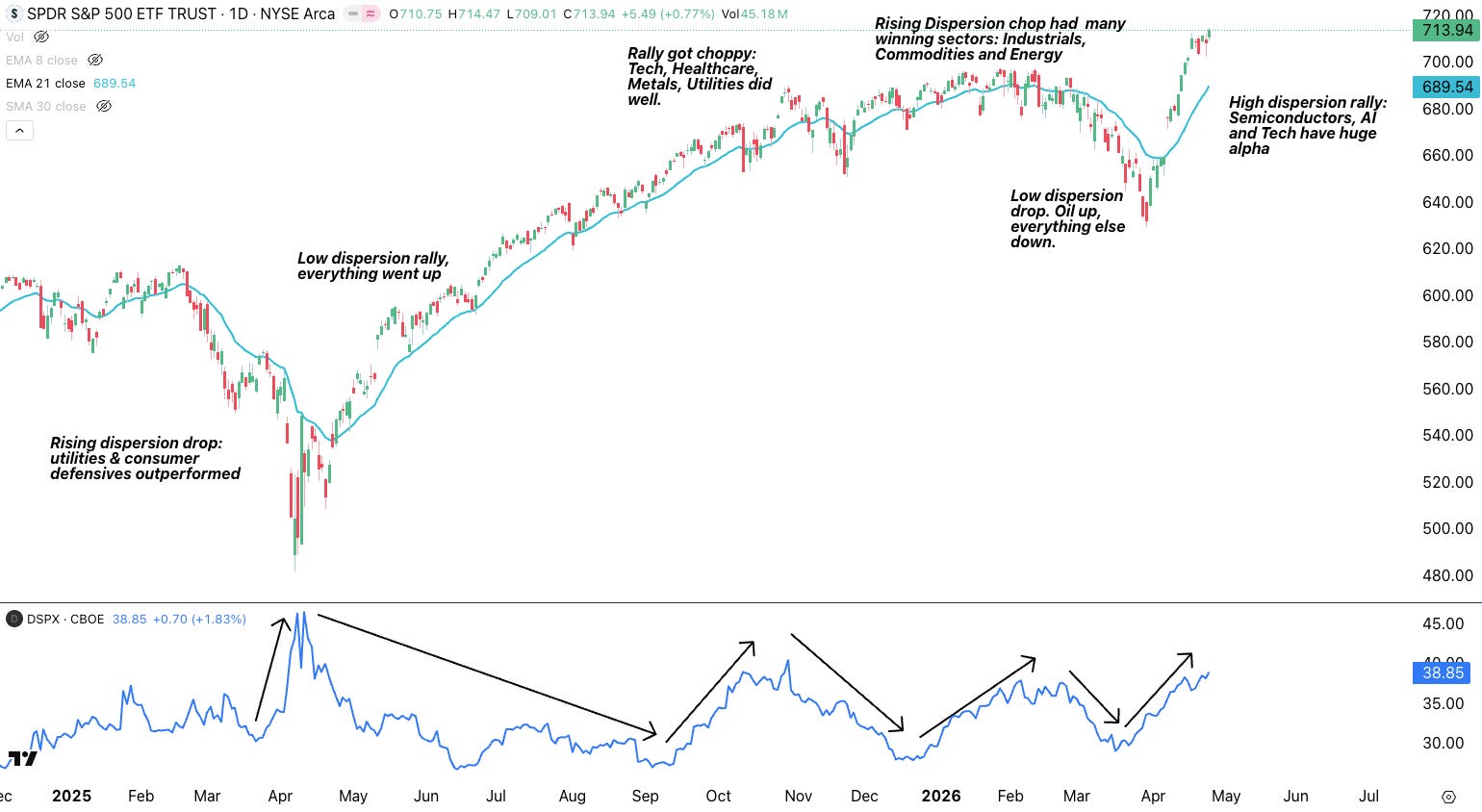
Looking at the chart above we’ll review the various dispersion regimes since January 2025.
The Tariff Tantrum correction of March & April 2025 was a high dispersion correction. There were areas of safety, as utilities and consumer staples outperformed.
The uptrend that followed in late April 2025 was a low dispersion uptrend, where everything rose together. It was a Macro driven rally, as systemic risk of Trump’s tariffs declined.
In September and October of 2025 the rally got more choppy as dispersion increased. Many areas of the market fell, but tech, healthcare metals and utilities outperformed. This was a Micro driven market where the aforementioned areas saw significant alpha to the market.
In November and December 2025 dispersion declined as earnings season came to an end. As the market inched higher, most sectors participated as trading was highly correlated.
Between January and March of 2026 dispersion increased and the Great Rotation led money out of tech and growth and into value, industrials, commodities and energy. A Micro driven market where investors were seeking lower valuation equities.
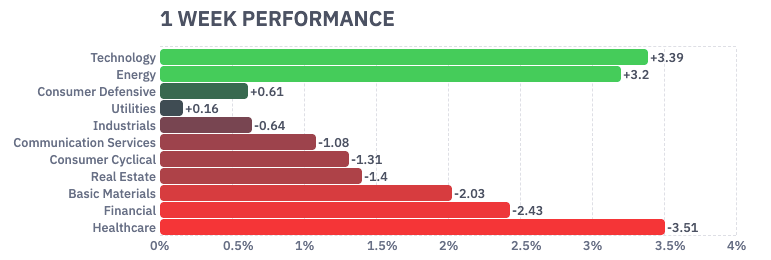
And now? The sector rotation chart shows few winning sectors and many losing ones — that’s proof of a high dispersion market.
In the Premium Section we’ll go over how to trade this high dispersion market.
Disclaimer — All materials, information, and ideas from Cycles Edge are for educational purposes only and should not be considered Financial Advice. This blog may document actions done by the owners/writers of this blog, thus it should be assumed that positions are likely taken. If this is an issue, please discontinue reading. Cycles Edge takes no responsibility for possible losses, as markets can be volatile and unpredictable, leading to constantly changing opinions or forecasts.