

New Opportunities
Premium Section: How to Invest in a Bear Steepening Regime

The financial markets work like a pendulum. They swing from one extreme to the other. Bullish to bearish and back again. When there is correction and value destruction, that sets up the opportunity for a bullish phase and value creation. It’s always the same and nothing is ever different.
We believe there will be an excellent opportunity to make money in the markets this fall; however, it is still too early. The recent bounce will probably run out of steam, and when that happens, further downside is possible.
The market is in a deleveraging mood, and there are still plenty of leveraged positions left to wash out. Markets excel at inflicting maximum pain, and twisting the arms of traders holding leveraged ETFs is easy low-hanging fruit.
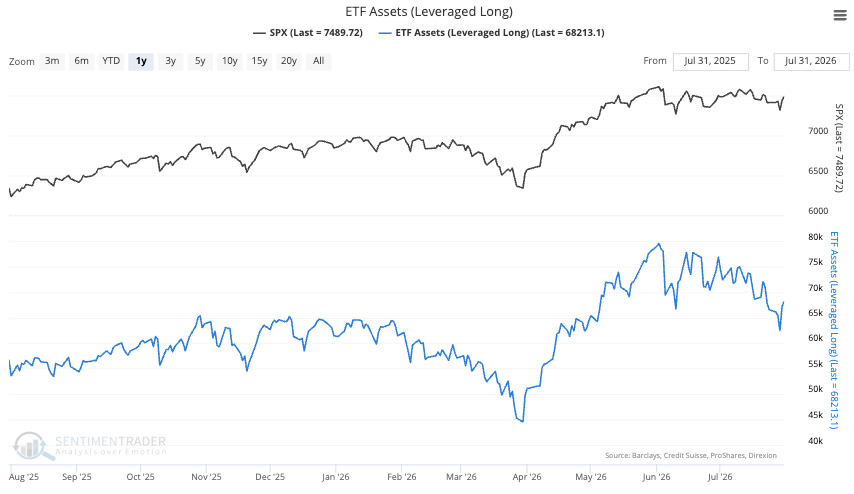
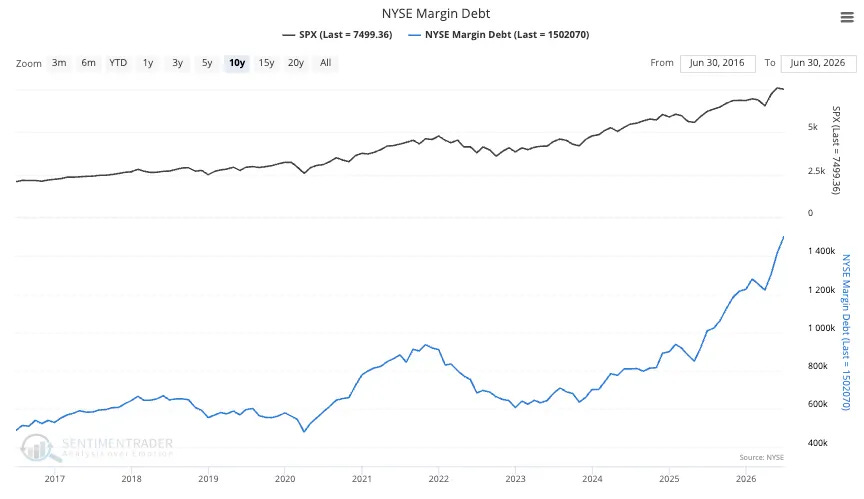
Record NYSE margin debt means the unwind isn't over. If the market wants to inflict maximum pain, triggering forced margin liquidations is the obvious next move.
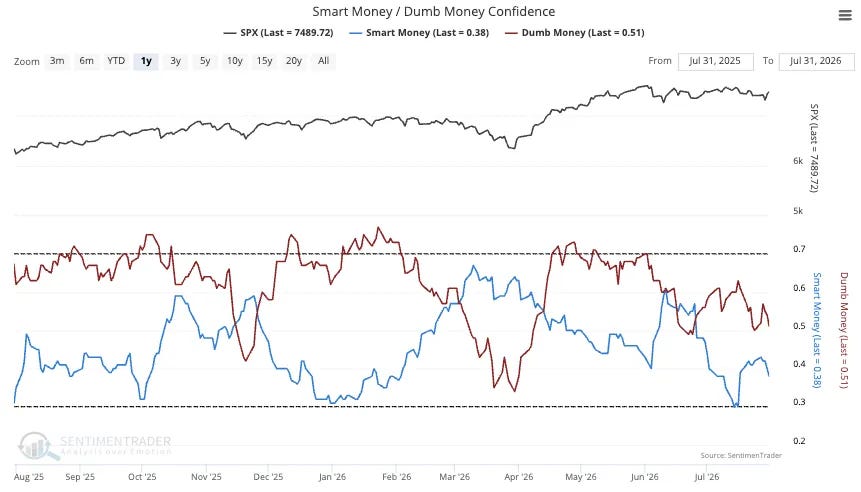
Smart Money and Dumb Money are both selling into recent strength. This supports our thesis that despite a bounce, further downside is probable before a lucrative new uptrend begins.
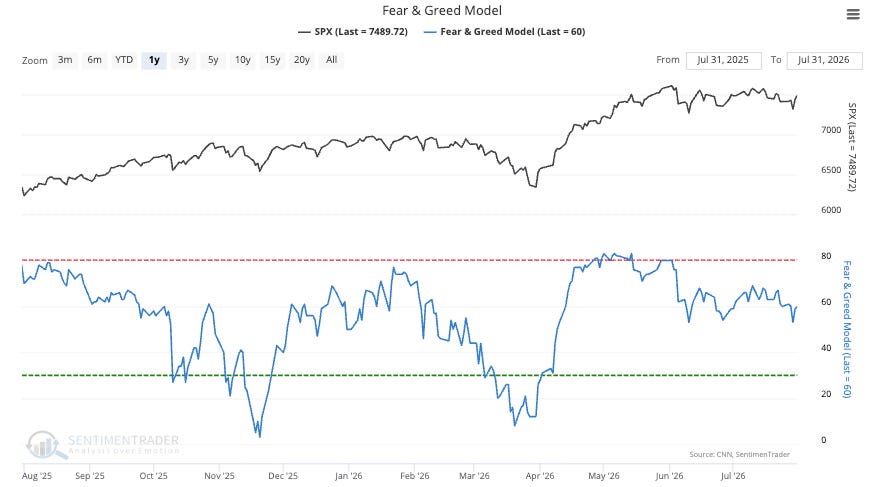
The Fear and Greed Model is in no-man’s-land right now and that is pretty consistent with typical low-volume summer chop trading.
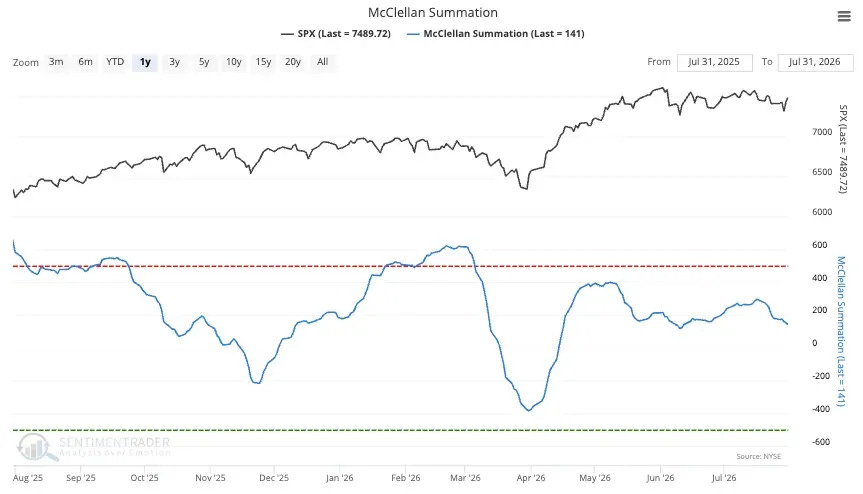
Breadth is still weak and declining as shown by the McClellan Summation Index.
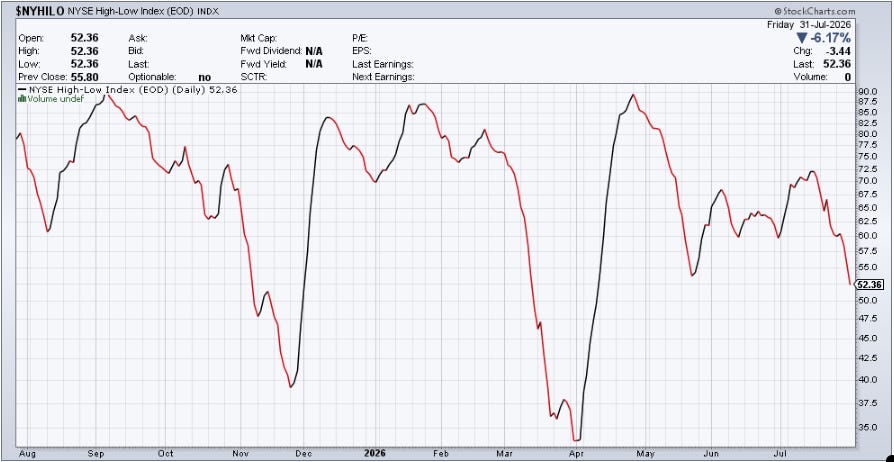
The NYSE High-Low Index also confirms that breadth is weak and it is a very hostile environment to invest in individual stocks right now.
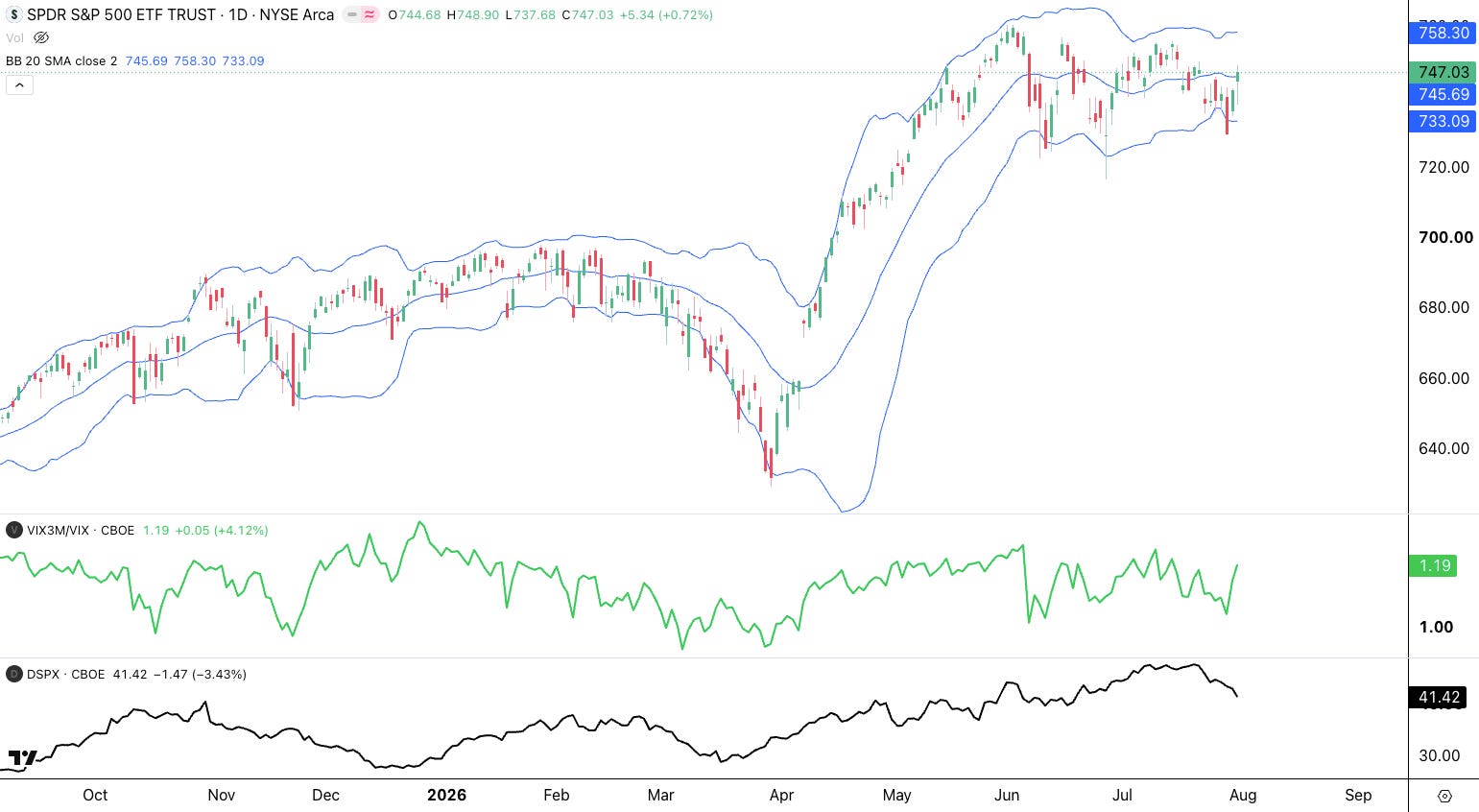
The S&P 500 (SPY) is just chopping sideways in what appears to be a topping pattern. If the June 2nd high holds, a real decline could begin after Labor Day when institutions come back from summer vacation. In the chart below, notice:
Price action is being contained in the Bollinger Bands and they are pointing sideways, displaying summer chop.
The VIX Curve (VXV/VIX) is close to 1.20, which often acts like an overbought signal. If the VIX Curve begins pointing down, another leg down is ready.
Dispersion (DSPX) is declining sharply. This means: 1) this is now a Macro-driven market and macro factors are bearish and 2) stock correlations are rising and different areas of the market are beginning to move more in unison. If the SPY starts a shaper downtrend, declining dispersion leaves the door open for a waterfall (sell-everything) drop, which could coincide with de-leveraging and margin debt liquidations.
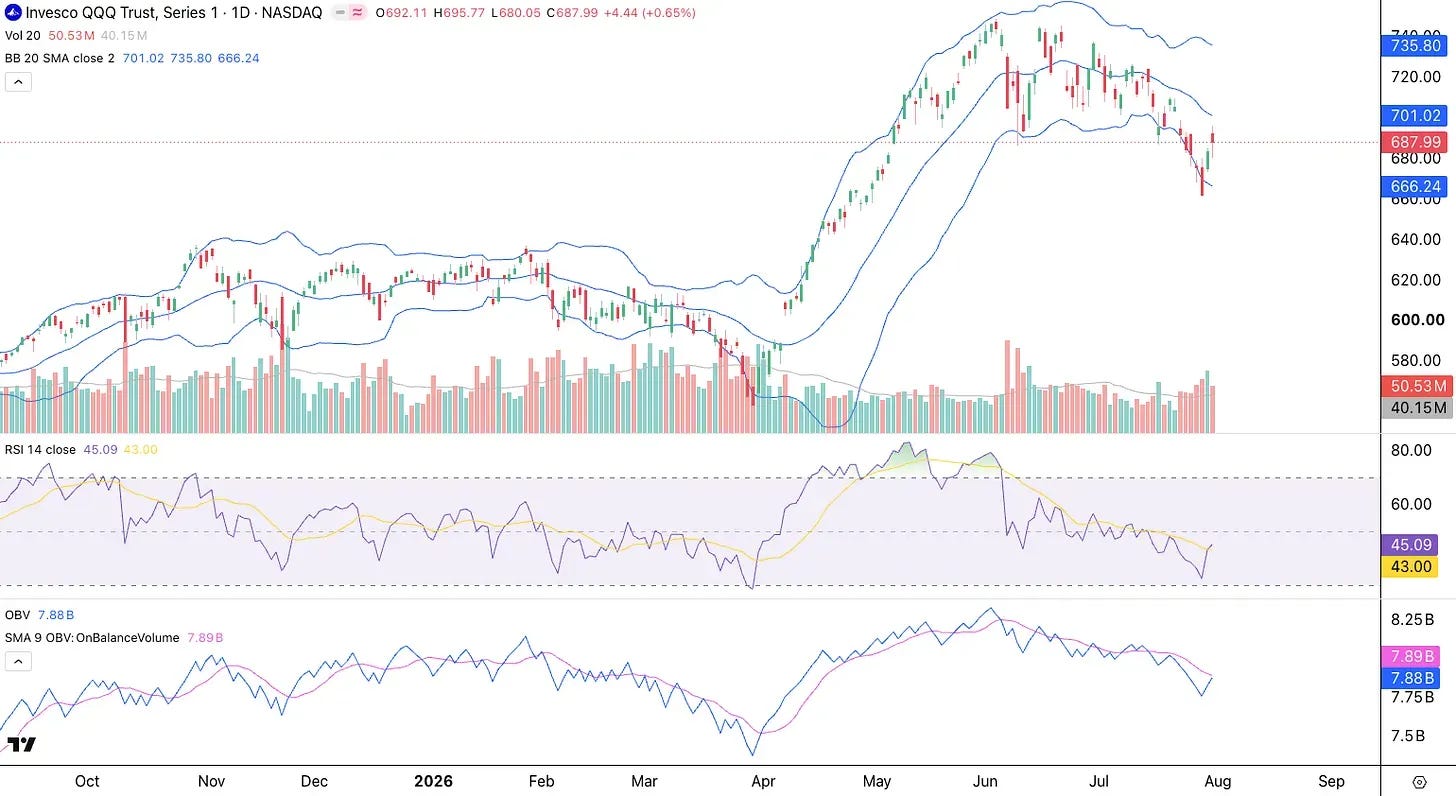
The Nasdaq 100 (QQQ) still has relative weakness vs. the SPY as it is still below the 20 SMA (or Bollinger Band Midline). RSI is still below 50 and On-Balance Volume (OBV) is still trending below it’s10 SMA, showing that sellers are still in control despite the recent bounce. Another leg lower is possible.
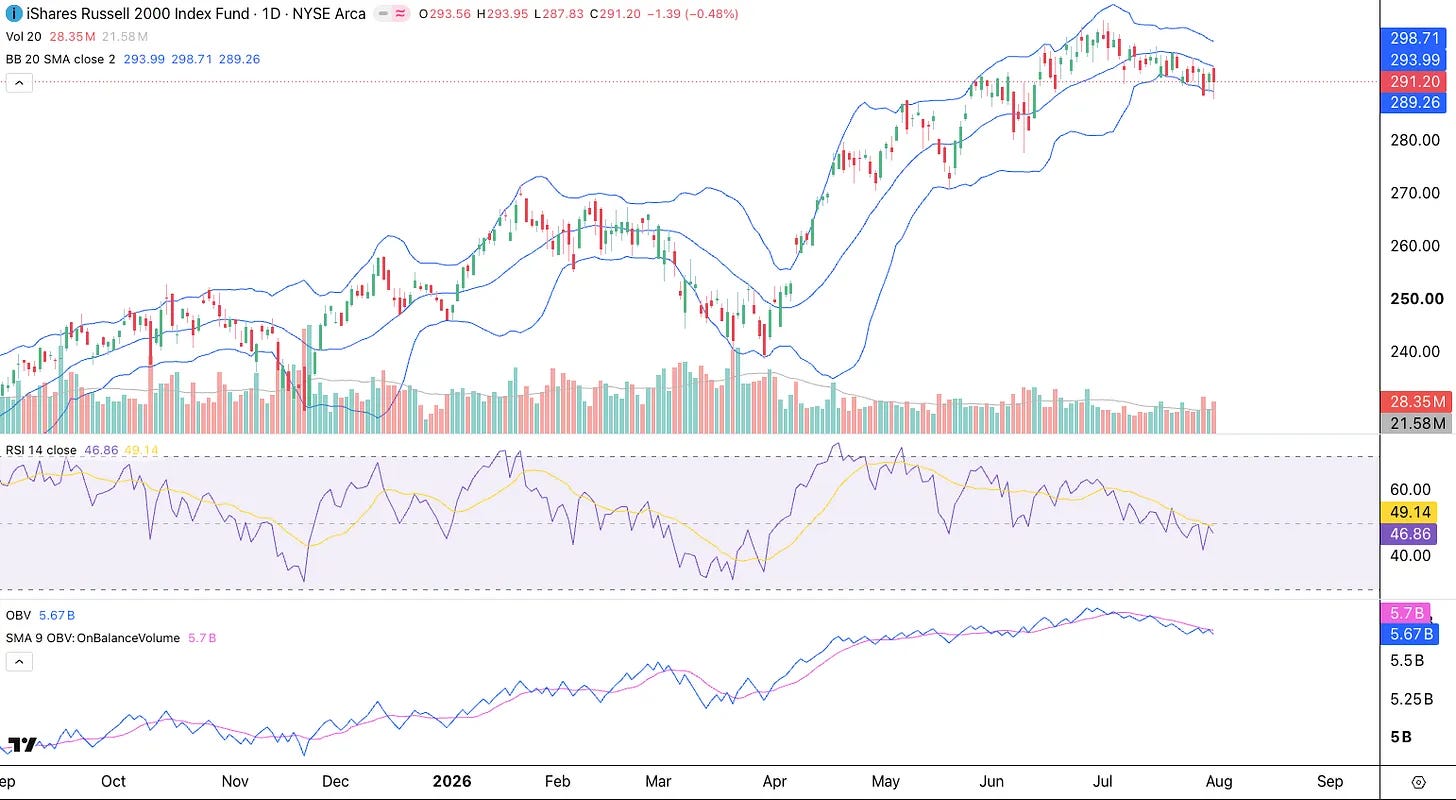
The Russell 2000 (IWM) appears to be transitioning from an uptrend to a downtrend. Notice how the price formed a rounded top pattern below the 20 SMA. Now, both the upper and lower Bollinger Bands are pointing down. The RSI is in a downtrend and below the 50 mark, signaling a loss of momentum. The OBV is also in a downtrend below its 10 SMA. Fundamentally, higher interest rates remain a strong headwind for small-cap companies, which often rely heavily on debt to fund operations.
Semiconductors (SOXX) look even weaker than QQQ and IWM. Friday closed with a heavy red candle on high volume beneath a declining 20 SMA. With Bollinger Bands downward-sloping, RSI sub-50, and OBV putting in lower highs and lower lows, technicals are breakdown-ready. The deleveraging wave in chip stocks isn't over.
Inside the Premium Section, we cover three key topics:
Our Cycles Roadmap: Pinpointing the exact time to buy the dip
Macro Breakdown: Navigating the bear steepening regime
Actionable Strategy: Where to deploy capital today
Disclaimer — All materials, information, and ideas from Cycles Edge are for educational purposes only and should not be considered Financial Advice. This blog may document actions done by the owners/writers of this blog, thus it should be assumed that positions are likely taken. If this is an issue, please discontinue reading. Cycles Edge takes no responsibility for possible losses, as markets can be volatile and unpredictable, leading to constantly changing opinions or forecasts.